Commitment and consistency
Commitment and consistency is the pull of a person's own earlier statement: doing something else means contradicting the person they just presented themselves as, so the stated intention carries a little extra weight.
The canonical demonstration is smaller and stranger than its reputation. Freedman and Fraser (1966) telephoned households twice, three days apart; the second call was identical for everyone, asking to send five or six men into the home for two hours to go through the cupboards and classify every household product. Compliance was 52.8% from people who had already answered eight questions about household soaps, 33.3% from those who agreed to answer and were then told they might be contacted, 27.8% from those who heard the questions but were never asked them, and 22.2% from those who received only the large request. Only the condition where the small request was actually performed beat the control; agreeing without doing differed from neither. Their second experiment is the famous one: 76.0% accepted a large, poorly lettered “Drive Carefully” sign for the front lawn after a small request on the same issue, against 16.7% of controls. The detail usually dropped is that the condition whose first request shared nothing with the second — different issue, different task, different person, weeks apart — still produced 47.4%, which is hard to read as consistency with a prior position and easy to read as a self-image as the kind of person who helps.
The meta-analytic record is modest. Beaman, Cole, Preston, Klentz and Steblay (1983) pooled 120 experimental groups and called the effect replicable but weak, with nearly half the studies producing no effect or an effect in the wrong direction. Burger's (1999) review puts the three earlier meta-analyses at r = .09 to .17, and his own pooled odds ratios locate where the effect lives: 1.47 when the first request was performed against a non-significant 1.16 when it was only agreed to, 1.91 when the second request continued the first task (53.28% compliance against 27.86% in controls), 1.58 when the first request demanded real involvement, and a weak 1.21 (r = .05) when the same person asked again with no delay — a cell in which about half of 24 studies favoured the control group, which Burger reads as reactance at a violated norm of give-and-take. Two manipulations reliably destroy it: telling people that few others comply, and paying them for the first step. Direct replication has not been kinder, either: Gamian-Wilk and Dolinski (2020) re-ran the original household-products procedure and found it worked in Ukraine but not Poland in 2003 and in neither country by 2013. The escalation form of this principle survives only where the user completes the first step themselves, unpaid, and the next ask continues the same task.
The version that reaches an interface is not request escalation but asking a question. Wood, Conner, Miles, Sandberg, Taylor, Godin and Sheeran (2016) meta-analysed 116 published tests of the question–behaviour effect, N = 54,985, and found d+ = 0.24, falling to 0.15 once funnel asymmetry was corrected for. The moderators matter more than the average: asking people to predict their behaviour gave d+ = 0.29, while asking only about intentions gave 0.12 with an interval containing zero. Effects were larger for socially desirable and easy behaviours, absent for risky ones (d+ = −0.05), larger in student samples than outside them (0.31 against 0.12), and shrank as the delay between question and behaviour grew. Rodrigues, French and Sniehotta (2016) contest even that, noting that Wood and colleagues included non-randomised studies and ran no risk-of-bias assessment: restricted to 33 randomised trials of health behaviour, their own estimate is d = 0.09 against Wood's 0.29 for the same domain, and two large preregistered trials — on colorectal cancer screening uptake and on organ donor registration — found no effect at all. Mechanism tests supported neither attitude accessibility, dissonance, behavioural simulation nor processing fluency, so an onboarding question is worth one screen at most, and has to earn the step it costs.
What holds up better is a commitment the user actively makes. Cioffi and Garner (1996) found that registering a volunteer decision by doing something produced more commitment than registering the identical decision by doing nothing, a difference that persisted over six weeks and showed up in behaviour — the empirical case for an explicit opt-in over a pre-ticked box. Baca-Motes, Brown, Gneezy, Keenan and Nelson (2013) had 2,416 hotel guests, unaware they were being observed, make a brief but specific commitment at check-in and wear a lapel pin for it: they were over 25% more likely to hang at least one towel for reuse, and hung over 40% more towels in total. Aggregated, this is real and small. Bergquist, Thiel, Goldberg and van der Linden (2023) pooled 10 meta-analyses covering 430 primary studies and put commitment approaches — goal setting, public commitments, implementation intentions — at d = 0.27 across 67 primary studies, behind social comparison (0.37) and financial incentives (0.32); publication-bias adjustment roughly halves that, to d = 0.14 under selection models and 0.13 under a weighted average of adequately powered studies. Plan for a few percentage points of behaviour, not a conversion lever.
The strongest-supported half of the principle is referencing the commitment later. Harkin, Webb, Chang, Prestwich, Conner, Kellar, Benn and Sheeran (2016) meta-analysed 138 randomised studies, N = 19,951, of prompts to monitor progress toward a goal and found d+ = 0.40 on goal attainment, with published and unpublished effects nearly identical (0.42 against 0.40). Monitoring whose results were physically recorded did better (0.43) than monitoring that was not (0.29), and private monitoring that was reported to someone did better (0.47) than private monitoring that was not (0.19). Public monitoring looked strongest at 0.55 but rests on three studies with an interval of [−0.16, 1.26], so “make it public” is the one piece of common advice here that the data does not carry. Locke and Latham (2002) give the shape of the thing being measured against: specific, difficult goals beat urging people to do their best, at .42 to .80, goal difficulty gives .52 to .82, and the relationship is strongest where the person is committed to the goal. A stored goal, a recorded count and a summary that puts one against the other is the best-evidenced screen in this entry.
One popular form has a clear null. Shu, Mazar, Gino, Ariely and Bazerman (2012) reported that moving a signature to the top of a form makes ethics salient and reduces dishonest self-reports; that paper has been retracted, and before the retraction Kristal, Whillans and colleagues (2020), working with the original authors, failed to replicate it across five conceptual replications (n = 4,559) and one highly powered preregistered direct replication (n = 1,235), observing no effect of signing first. In the same territory, Verschuere and colleagues (2018) pooled 19 direct replications of the moral-reminder experiment (n = 4,674) and found participants given a moral reminder reported solving 0.11 more matrices, 95% CI [−0.09, 0.31], Cohen's d = −0.04, against d = 0.48 in the original. A pledge box or a signature at the top of a form is not an honesty control.
The honest summary is mixed, and the grade depends on which claim you are buying. A voluntary, specific, actively made commitment that you record and reflect back is a defensible small intervention — d in the region of 0.13 to 0.27 once publication bias is accounted for. The escalation version, extract a small yes and then trade on it, rests on a 1966 study whose effect size has never been reproduced, a meta-analytic record where nearly half the studies found nothing or the opposite, and direct replications that came out null. The honesty-pledge version is retracted and replicated to zero.
When it holds
- Active, not passive. Registering a decision by doing something produced more commitment than registering the identical decision by doing nothing, so a pre-ticked box is not a commitment the user made.
- Carried out, not merely promised. Performing the first request gave an odds ratio of 1.47 against a non-significant 1.16 for merely agreeing to it.
- Specific, not aspirational. Specific, difficult goals beat “do your best” at .42 to .80, because a vague goal has no external referent and accepts almost any outcome.
- Prediction, not intention. Asking people to predict their behaviour gave d+ = 0.29; asking only about intentions gave 0.12, with a confidence interval spanning zero.
- Recorded and reflected back. Monitoring that was physically recorded gave d+ = 0.43 against 0.29 when it was not, and private monitoring reported to someone gave 0.47 against 0.19 when unreported. Public monitoring was numerically largest but rests on three studies with an interval crossing zero.
- Soon, and on something easy and desirable. Effects shrank as the delay between question and behaviour grew and were absent for risky behaviours (d+ = −0.05).
- Not immediately, from the same voice, on an unrelated ask. That cell was a weak odds ratio of 1.21 (r = .05) with about half of 24 studies favouring the control group.
- Not when you supply an outside reason for the first step. Paying people for it, and telling them few others comply, both make compliance decrease.
- The person and the setting both move it. High scorers on preference for consistency show a stronger effect than low scorers, and the direct replication worked in one country in 2003 and in neither by 2013, with compliance falling over the decade.
How to apply
- Open onboarding with one question the user answers in their own words or numbers — what they want out of this, how often, by when — and store the answer as data you can render later, not as an analytics event.
- Word it as a self-prediction rather than an attitude: “how many times a week will you do this?” instead of “how important is this to you?”
- Make the commitment something the user performs: types the number, picks the days, taps a specific option. Never a pre-ticked box or a default you inferred.
- Store it in specific, dated form. “Three sessions a week, Monday, Wednesday and Friday” is the shape that holds up, and it is the hand-off point to implementation intentions.
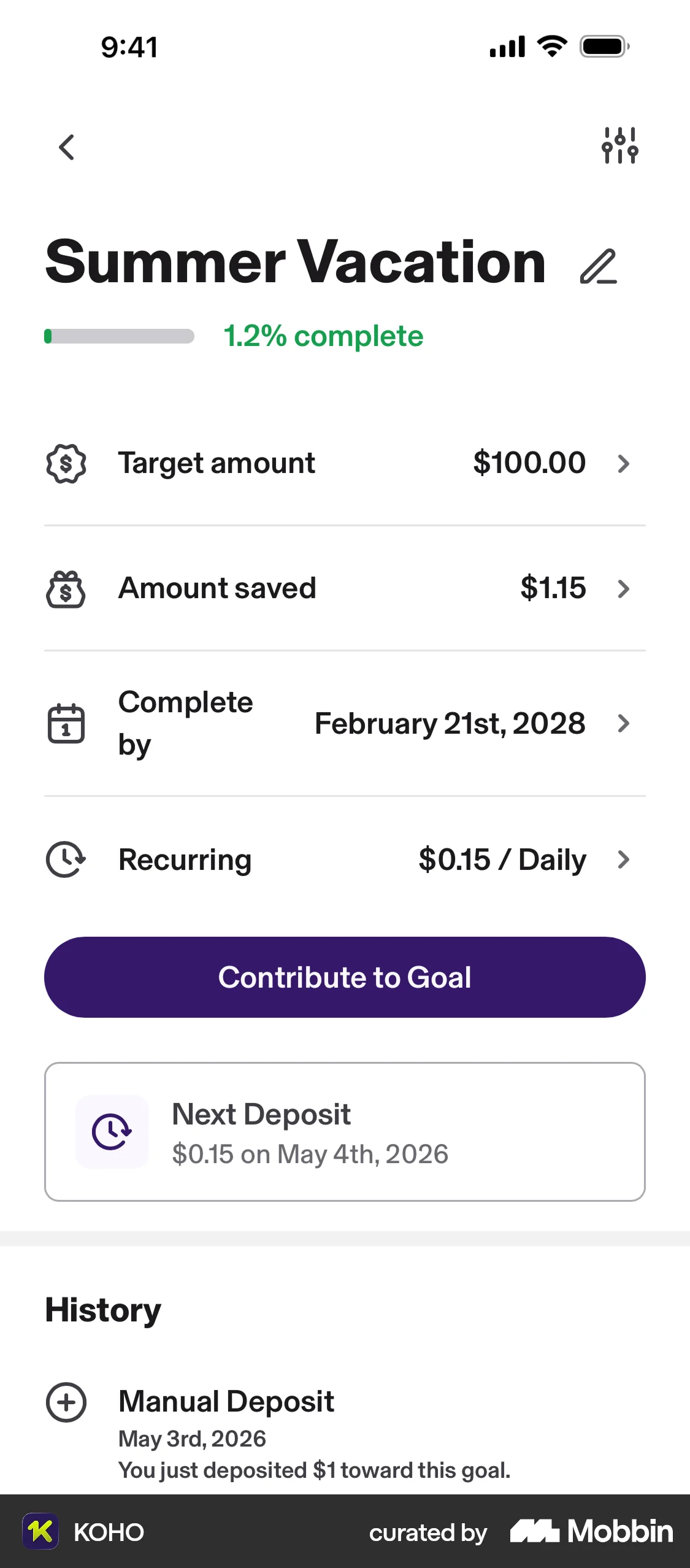
- Quote the stored commitment back where it is relevant — the empty state, the weekly summary, the reminder copy — next to the recorded count of what the user has actually done.
- Put an edit control beside every displayed commitment, so revising it is one tap from where it appears. A commitment the user cannot change is a setting you imposed.
- Size the first commitment so it can be completed in the session, and let the user finish it before asking for anything larger.
- Attach no discount, bonus or reward to making the pledge itself. Paying for the first step is one of the two manipulations that remove the effect, and it hands the user an external reason for what they just did.
What to avoid
- Turning a stated goal into leverage for a purchase. Using an onboarding answer to argue that declining the paid plan contradicts what the user said is confirmshaming — Mathur and colleagues found 169 instances across 164 of roughly 11,000 shopping sites, with decline options worded “No thanks, I like paying full price”.
- Inferring the commitment. Under Article 22 of the Consumer Rights Directive 2011/83/EU the trader must seek express consent for any additional payment, and where consent was inferred from default options the consumer had to deselect, the consumer is entitled to reimbursement.
- Commitments the user cannot walk back. Where the commitment is a consent, GDPR Article 7(3) is explicit: the data subject may withdraw at any time, and it shall be as easy to withdraw as to give consent. Build to that standard for product-level commitments too.
- Escalating in the same breath from the same screen. The same-requester, no-delay condition is the weakest cell in the literature and the one where half the studies went backwards.
- Treating a pledge or a signature box as an honesty control. The signing-first result is retracted and failed a preregistered replication run with the original authors, and the moral-reminder effect replicated to d = −0.04.
- Writing the commitment in your words and attributing it to the user. A goal the user did not set is an assignment, and the goal-setting evidence holds only where the person is committed to the goal.
- Using the commitment as a guilt reference later. “You said you wanted this — don't give up now” is the pressure version; “your goal: three sessions a week” is the monitoring version, and only the second is what the evidence supports.
Real-world examples




Measuring it
- Primary metric: follow-through on the committed behaviour inside the window the user named, comparing a cohort asked the commitment question with one that was not, and segmented by the delay between the two. The question has to be the only difference between arms.
- Secondary: the revision rate on stored commitments. Users editing their goal is evidence the control is real, not a failure — a revision rate near zero usually means the edit path is hidden.
- Backfire metric: drop-off at the commitment step itself. A third of Freedman and Fraser's participants refused even the small request, and none of those who refused complied later, so an early ask that is too large costs you the users it filters out.
- Backfire metric: unsubscribe, notification-off and uninstall rates after the first message that references the stated goal. Reactance shows up as withdrawal, not as complaint.
- Backfire metric: refund, cancellation and chargeback rates on anything sold in the same flow as a commitment. A consistency-pressured upgrade converts and then unwinds, and a conversion-only dashboard will not show it.
References
- Freedman & Fraser (1966). Compliance Without Pressure: The Foot-in-the-Door Technique. Journal of Personality and Social Psychology.
- Beaman, Cole, Preston, Klentz & Steblay (1983). Fifteen Years of Foot-in-the-Door Research: A Meta-Analysis. Personality and Social Psychology Bulletin.
- Burger (1999). The Foot-in-the-Door Compliance Procedure: A Multiple-Process Analysis and Review. Personality and Social Psychology Review.
- Gamian-Wilk & Dolinski (2020). The Foot-in-the-Door Phenomenon 40 and 50 Years Later: A Direct Replication of the Original Freedman and Fraser Study in Poland and in Ukraine. Psychological Reports.
- Wood, Conner, Miles, Sandberg, Taylor, Godin & Sheeran (2016). The Impact of Asking Intention or Self-Prediction Questions on Subsequent Behavior: A Meta-Analysis. Personality and Social Psychology Review.
- Rodrigues, French & Sniehotta (2016). Commentary: The Impact of Asking Intention or Self-Prediction Questions on Subsequent Behavior. Frontiers in Psychology.
- Cioffi & Garner (1996). On Doing the Decision: Effects of Active versus Passive Choice on Commitment and Self-Perception. Personality and Social Psychology Bulletin.
- Baca-Motes, Brown, Gneezy, Keenan & Nelson (2013). Commitment and Behavior Change: Evidence from the Field. Journal of Consumer Research.
- Bergquist, Thiel, Goldberg & van der Linden (2023). Field Interventions for Climate Change Mitigation Behaviors: A Second-Order Meta-Analysis. PNAS.
- Harkin, Webb, Chang, Prestwich, Conner, Kellar, Benn & Sheeran (2016). Does Monitoring Goal Progress Promote Goal Attainment? A Meta-Analysis of the Experimental Evidence. Psychological Bulletin.
- Locke & Latham (2002). Building a Practically Useful Theory of Goal Setting and Task Motivation: A 35-Year Odyssey. American Psychologist.
- Kristal, Whillans, Bazerman, Gino, Shu, Mazar & Ariely (2020). Signing at the Beginning versus at the End Does Not Decrease Dishonesty. PNAS.
- Verschuere et al. (2018). Registered Replication Report on Mazar, Amir, and Ariely (2008). Advances in Methods and Practices in Psychological Science.
- Mathur, Acar, Friedman, Lucherini, Mayer, Chetty & Narayanan (2019). Dark Patterns at Scale: Findings from a Crawl of 11K Shopping Websites. Proceedings of the ACM on Human-Computer Interaction.
- Regulation (EU) 2016/679 (GDPR), Article 7(3): consent must be as easy to withdraw as to give.
- Directive 2011/83/EU on consumer rights, Article 22: express consent required for additional payments, with reimbursement where consent was inferred from default options.
For agents
An agent-friendly guide to this principle lives at /agents/commitment-and-consistency.md.
Our MCP server and skills for all principles are coming soon.
Similar principles
Disclaimer: The theories here are just that — theories. They may not apply universally and should be considered in context. Use your own judgment and consult additional sources when applying these principles.