Fresh start effect
The fresh start effect is the motivation boost people feel after a temporal landmark, like a Monday, a birthday or a new year, which makes past failures feel like they belong to an old self.
The mechanism Dai, Milkman and Riis propose is mental accounting applied to time. A landmark closes one accounting period and opens another, so the record of missed workouts and abandoned diets stays filed under the period that just ended. The carrier they measured was dissociation from the past, imperfect self: participants shown a date framed as a new beginning expected to feel more disconnected from their past selves, and that rating mediated the increase in goal motivation (indirect effect b = 0.07, 95% bias-corrected CI [0.003, 0.22], and [0.01, 0.29] in a supplementary replication). Both intervals clear zero only narrowly, so the mechanism is indicated rather than settled. A landmark also pushes people out of execution and into big-picture thinking, which favours desirability over feasibility, so the costs of starting look smaller. And a dated landmark is more salient than an interval, which is why “after your next birthday” and “in two months” behave differently on the same button even when they name the same day.
The founding paper is three archival field studies. Daily United States Google search volume for “diet” across 3,104 days from January 2004 to June 2012 rose 14.4% at the start of a new week, 3.7% at a new month, 82.1% at a new year and 10.2% after a federal holiday; placebo terms (news, gardening, laundry, weather) showed no comparable pattern. Card-reader records covering every undergraduate member of a university gym (11,912 members, 442 days, 5,265,104 person-days) put the probability of a visit 33.4% higher at the start of a week, 14.4% at a month, 11.6% at a year, 47.1% at a semester and 24.3% on the first day back from a school break. Commitment contracts created by 43,012 stickK.com users rose 62.9% at the start of a week, 23.6% at a month, 145.3% at a year, 55.1% after a federal holiday and 2.6% after a birthday. Of those, only the week start recurs often enough to build a repeating job around.
The weekly pattern replicates in independent data. Ayers and colleagues applied a wavelet decomposition to Google queries about quitting smoking in six languages from 2008 to 2012 and found Monday volumes 25% (95% CI 24–26%) above the Tuesday-to-Sunday mean, with Monday significantly higher in 33 of 36 day-pair comparisons; the paper was funded through a cooperative agreement with The Monday Campaigns and one author worked there. Fast and colleagues triangulated five Winnipeg datasets collected between 2012 and 2019, predicting that cycling to work would not follow the effect, and found that it did: the three trails with commuter-shaped daily profiles carried 22% less traffic on Friday than Monday, 147 fewer cyclists a day (95% CI 95 to 199 fewer), while the two leisure trails did not change significantly (22 fewer, 95% CI 59 fewer to 15 more). Accesses to a large employer's protected bike park (56,307 over seven years) fell about 20% from Tuesday to Friday, Tuesday being that site's landmark because the company closed every second Monday. Their positive control, fitness-centre attendance, fell 21% across the week, 592 fewer visits a day (95% CI 425 to 759 fewer), and their negative controls moved the other way: car counts rose about 7% and coffee sales about 10%. It is observational, one city, no individual-level data, and two co-authors work for the firms that supplied the coffee and parking records. If you send one prompt a week, the first working day is the slot the data supports, and the relevant first day is the user's week, not the calendar's.
All of that is correlational. The causal evidence is five laboratory experiments in which the only thing manipulated was the label on a date. Offered a list of dates for a goal reminder, 25.61% of participants chose 20 March as “the first day of spring” against 7.23% as “the third Thursday in March” (N = 165, p = .001); in a student sample, 28.57% chose 14 May as “the first day of Penn's summer break” against 4.35% as “Penn's Administrative Day” (N = 278, p < .0001). The behaviour behind those choices is thin: in another experiment 82% of the landmark group and 90% of the control group clicked no goal-related links at all, a mean of 0.62 against 0.21 clicks (N = 216, p = .01). Only three of the five measured an act at all: the other two collected motivation ratings, one about a hypothetical stranger and one about an imagined apartment move, and the mediation result rests on those ratings rather than on behaviour. The label on the date is the lever, and the lever is light.
One randomised field experiment, by Beshears and colleagues, tests the framing on consequential behaviour. Mailings to 6,082 university employees offered an immediate retirement contribution increase or a scheduled future one. Framing the future date as a fresh start (next birthday, New Year's, first day of spring) rather than as an interval (“in 2 months”) raised take-up of the delayed option by 1.3–1.4 percentage points on a control base of 2.6%, a 50–54% relative increase; take-up of either option rose 2.2–2.3 points on a base of 7.6%, and average contribution rates over the next eight months rose 17–19 basis points against 73, a 23–26% increase. Placebo landmarks that pre-testing showed do not feel like new beginnings (Thanksgiving, Martin Luther King Day, Valentine's Day) produced no positive effect, and fresh-start framing beat placebo framing by 1.7–1.8 points on delayed take-up. Take-up of the immediate option did not fall, but that estimate was not significant and Bayes factors modestly favoured the null, so treat “it does not cannibalise acting now” as untested rather than shown.
The same programme contains the strongest warning. In the companion working paper covering all 8,682 randomised employees at four universities, offering a delayed option at all, without landmark framing, lowered average contribution rates by 14 basis points for the targeted plan and 27 basis points across all plans compared with offering only an immediate increase, apparently because “later” leaks the message that saving is not urgent. Fresh-start framing recovered about 10 basis points, concentrated in birthday framing (22 basis points on the targeted plan, 33 across all plans) while holiday framing did not reach significance; the published paper reports the same contrast. A landmark label is a repair for a delayed option, not an improvement on asking people to start now.
Nulls exist and are not obscure. In a preregistered study by Milyavskaya and colleagues, 362 people rated three goals each on 16 characteristics in January or in March, and their ratings came out very similar in the two months; the differences that appeared were tied to goal age, not the calendar. A Center for Advanced Hindsight pilot mailed welcome boxes to 1,310 new movers in three North Carolina cities, testing the move itself as the landmark, and found no significant difference in drive-alone mileage (71.4 against 79.2 miles) or drive-alone rate (60.7% against 64.0%). The effect has also never been through a megastudy: the 61,293-member gym megastudy that tested 54 four-week programmes carries no fresh-start arm, so nothing puts this framing against planning prompts, reminders or micro-incentives at scale. That megastudy is the best available estimate of how long such boosts last: 45% of its interventions raised weekly visits by 9–27% during the programme, but only 8% produced change still measurable afterwards. Build the landmark as a scheduling trick for initiation, and put something else in the product for week two.
When it holds
- The landmark has to feel like a beginning to this person: dates that pre-tests classified as non-beginnings produced nothing in the savings experiment. Relabelling 5 October as “the first day after Yom Kippur” raised reminder take-up among Jewish participants (n = 86) and had the opposite effect among non-Jewish participants (n = 892), interaction p = .02, so a landmark that is not the user's can push the wrong way.
- Personal landmarks beat shared ones when the two were compared head to head. Birthday framing carried the savings result; holiday framing did not reach significance in the four-university analysis.
- The boost decays, and how fast depends on the landmark: a holiday produces a spike on the first workday after it that falls away quickly, while week, month, year and semester effects decline gradually. Expect a timing shift measured in days, not a durable change in habit.
- Resets help people who were failing and hurt people who were not. Across three experiments and 40 years of professional baseball records, unanticipated performance resets raised self-efficacy, motivation and later performance after weak performance, and lowered all three after strong performance.
- Even a birthday can reverse. In the gym data the first birthday regression came out with the opposite sign to the prediction; the effect appeared only once 21st birthdays were separated out, because students reduced attendance after turning 21, and the reported 7.5% birthday boost excludes them.
- Anticipating a landmark can delay action and cost real money. In a field experiment by Hennecke and Converse, aspiring dieters were willing to give up a week of access to an expensive weight-loss programme in order to start on a day they saw as following a temporal boundary, because planners discount situational constraints on post-boundary days.
- The evidence is about initiation, not attainment. Searches, gym entries, contract creations, reminder sign-ups and contribution elections are all starts; no study here follows whether the goal was reached.
- Landmarks with negative valence, such as a bereavement or a divorce, are explicitly outside the tested set, and the original authors doubt the effect extends to them unaltered.
- The archival data cannot fully separate landmarks from scheduling. Students are freer early in a semester and gym attendance falls as exams approach; the authors control for exam periods and the Winnipeg negative controls move the other way, but the weekly pattern still coincides with the shape of the working week.
How to apply
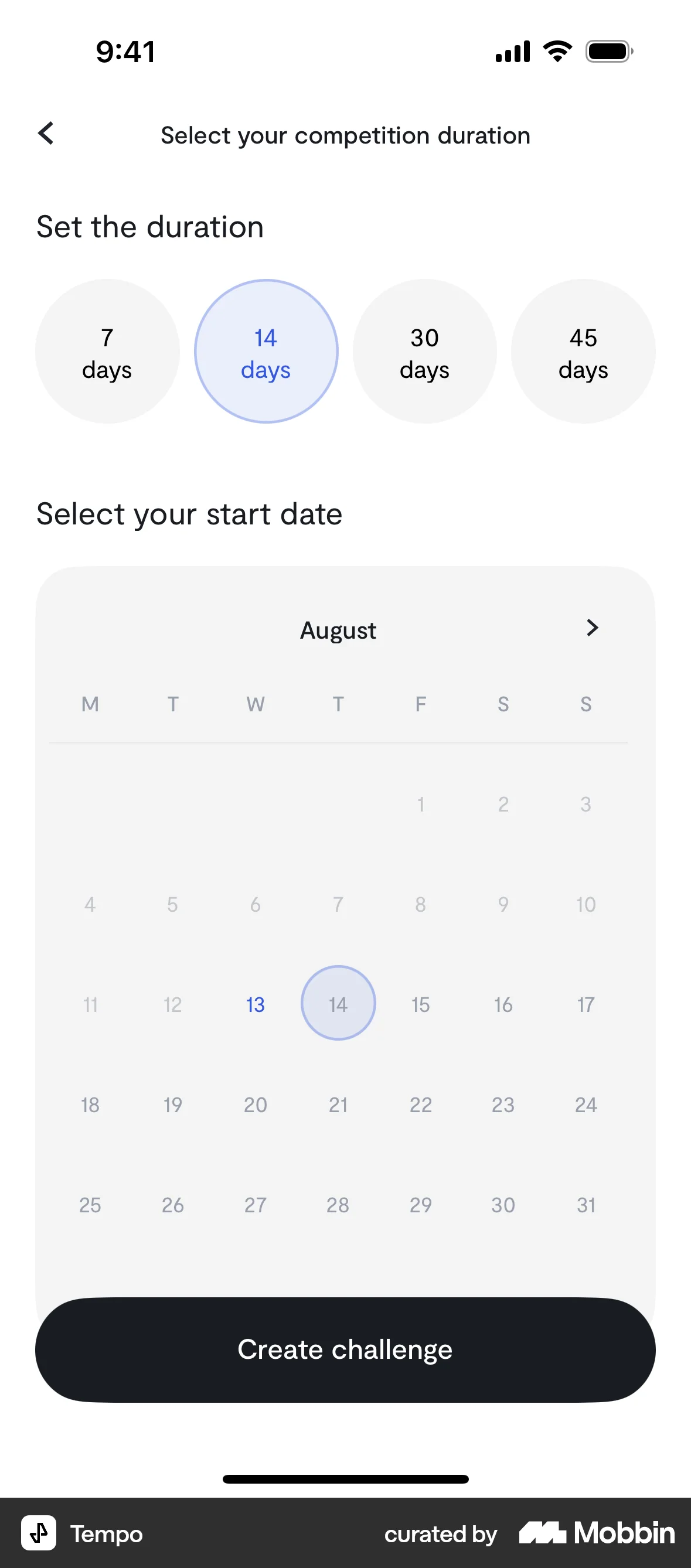
- Preselect the start date, not the delay. Name the day and name why it is a beginning (“Start on Monday 3 March”, “Start the day after your birthday”) rather than “in two months”; the label on the same date is what moved money in the only field experiment.
- Keep “start now” as the primary action and put the landmarked future start next to it, never in place of it. Adding a “later” option can cost more than the landmark label wins back.
- Draw the date from landmarks the user owns: account anniversary, birthday, the first day back from a holiday they booked, the first day in a new home or role. Personal landmarks outperformed calendar holidays where both were tested.
- Schedule the weekly summary and the next goal prompt for the first working day, and keep the ask to one action.
- Close the period explicitly in an annual recap before you open the next one, then offer a single next goal. The recap is what makes the landmark a boundary.
- Scope a goal reset to the thing that blocked the user and let them keep the record they earned: reset the broken streak, not the lifetime total, and never offer the reset to a user who is on track.
- Let users pick their own start date from a short list that includes the next natural beginning. Both landmark experiments worked through a date choice, not a persuasive argument.
- Attach something that carries the goal after the date: an implementation intention for the chosen day, a reminder scheduled on it, a default that activates on it. The landmark buys one act of initiation and nothing beyond it.
What to avoid
- Blasting resolution campaigns at everyone each January and calling it a strategy. The measured boost is one short-lived initiation spike per landmark, not a licence for a season of messaging.
- Building the copy on guilt about past failure. The mechanism is dissociation from the past self, so offer the clean slate and do not itemise what the user failed to do.
- Using a landmark to move someone from “now” to “later”. The delayed option reduced savings in the field, and a landmark label only partly repaired it.
- Imposing a reset. Wiping progress demotivates the users who had progress, with measured losses in self-efficacy and performance.
- Making the landmark the only route in. If the landmark start is the cheapest or only good option, you are charging people for the calendar, as in the weight-loss study where dieters forfeited a week of access.
- Landmark re-engagement by email or SMS is direct marketing. In the UK, regulation 22 of the Privacy and Electronic Communications (EC Directive) Regulations 2003 requires prior consent for unsolicited direct-marketing email to individual subscribers, with a narrow soft opt-in for existing customers' similar products that still requires a simple means of refusal in every message; the EU equivalent is Article 13 of Directive 2002/58/EC.
- Inventing the deadline on the landmark offer. Falsely stating that a product is available only for a limited time, or only on particular terms for a limited time, to elicit an immediate decision is a banned practice in all circumstances under Schedule 20 paragraph 7 of the Digital Markets, Competition and Consumers Act 2024, in force since 6 April 2025. If the January price is the normal price, say so.
Real-world examples


Measuring it
- Primary metric: goal initiation rate on and just after the landmark, compared with the same weekday in matched non-landmark weeks rather than with the weekly average. Report percentage points as well as relative terms; the field effect was 1.3 points on a 2.6% base.
- Count total starts across the whole window, not starts on the landmark. The failure mode is shifting starts that would have happened anyway, which looks like a win on landmark-day conversion and shows up as flat totals.
- Follow the landmark cohort for four and eight weeks. Initiation is the only thing this effect is known to move; persistence is where comparable programmes lose almost all of their effect.
- Backfire metrics: opt-out and unsubscribe rate on landmark campaigns, and the subsequent activity of users who were already active when the reset or recap arrived. A reset that lifts lapsed users while depressing engaged ones can net to zero in aggregate.
References
- Dai, Milkman & Riis (2014). The Fresh Start Effect: Temporal Landmarks Motivate Aspirational Behavior. Management Science.
- Dai, Milkman & Riis (2015). Put Your Imperfections Behind You: Temporal Landmarks Spur Goal Initiation When They Signal New Beginnings. Psychological Science.
- Beshears, Dai, Milkman & Benartzi (2021). Using Fresh Starts to Nudge Increased Retirement Savings. Organizational Behavior and Human Decision Processes.
- Beshears, Dai, Milkman & Benartzi (2016). Framing the Future: The Risks of Pre-Commitment Nudges and Potential of Fresh Start Messaging. Working paper.
- Dai (2018). A Double-Edged Sword: How and Why Resetting Performance Metrics Affects Motivation and Performance. Organizational Behavior and Human Decision Processes.
- Hennecke & Converse (2017). Next Week, Next Month, Next Year: How Perceived Temporal Boundaries Affect Initiation Expectations. Social Psychological and Personality Science.
- Ayers, Althouse, Johnson & Cohen (2014). Circaseptan (Weekly) Rhythms in Smoking Cessation Considerations. JAMA Internal Medicine.
- Fast et al. (2025). Urban Cycling-Specific Active Transportation Behaviour Is Sensitive to the Fresh Start Effect. International Journal of Behavioral Nutrition and Physical Activity.
- Milyavskaya, Thorne, Sullivan & Esselink (2025). Goals Across Time Frames and Temporal Landmarks: Do Time of Year and Goal Age Influence Goal Perceptions? Psychological Reports.
- Milkman et al. (2021). Megastudies Improve the Impact of Applied Behavioural Science. Nature.
- Center for Advanced Hindsight (2023). Fresh Start Effect in New Movers: A Pilot to Reduce SOV Trips.
- The Privacy and Electronic Communications (EC Directive) Regulations 2003, regulation 22.
- Digital Markets, Competition and Consumers Act 2024, Schedule 20, paragraph 7.
For agents
An agent-friendly guide to this principle lives at /agents/fresh-start-effect.md.
Our MCP server and skills for all principles are coming soon.
Similar principles
Disclaimer: The theories here are just that — theories. They may not apply universally and should be considered in context. Use your own judgment and consult additional sources when applying these principles.